
Export Guide
What does the EU-India trade deal mean for Indian garment exporters?
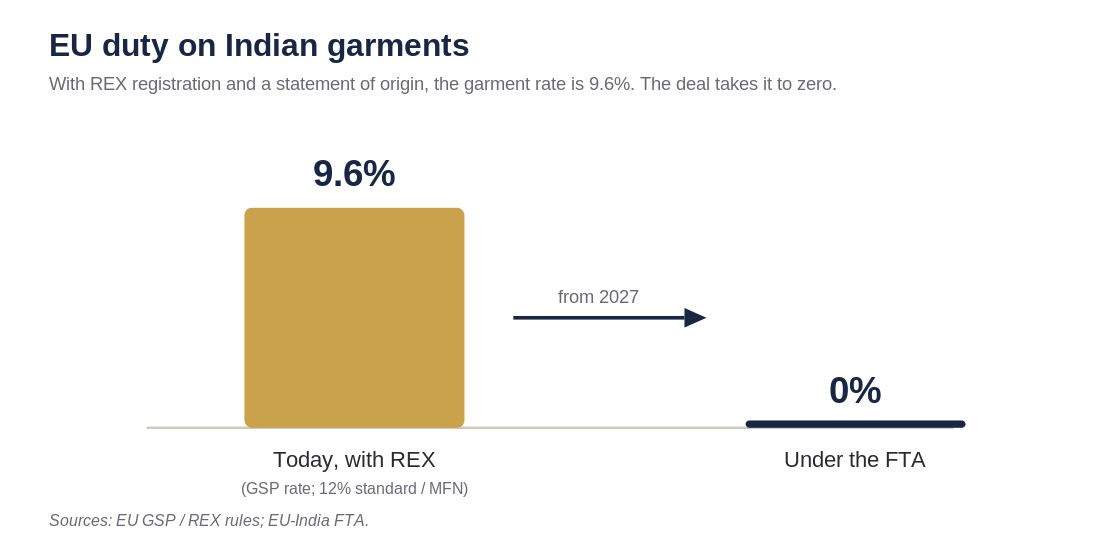
The EU-India trade deal takes duties on Indian garments to zero, which means Indian exporters lose the tariff cost that priced them out of European orders. But the duty is only the opening: a new analysis by INQOVA, which studied India-Europe garment trade flows from 2022 to 2026, shows the months ahead decide who actually wins it. Here's what the deal does, what their data says, and why timing matters.
What does the EU-India deal change, and when?
The EU-India free trade agreement concluded negotiations on 27 January 2026 and enters into force once both sides ratify it, expected in 2027 (Indian Textile Magazine, CNBC). That is the window: today's tariffs run until the agreement takes hold.
The duty you pay today depends on your paperwork. The standard rate on apparel into the EU is 12%. An Indian exporter registered in the EU's Registered Exporter system (REX), who prints a statement of origin on the commercial invoice, can claim the GSP preferential rate of 9.6% on garments instead (EU GSP rules). Worth noting: reports in early 2026 say the EU has begun withdrawing India's GSP preferences, which would push apparel back toward the full 12% (Policy Circle), so confirm your current rate with your customs partner. Either way, the trade agreement settles it: zero, across readymade garments, home textiles, man-made-fibre apparel and more.
The duty drop is worth roughly half a billion dollars a year to Indian garment exporters at today's volumes, by INQOVA's reckoning, before a single extra order of growth. That's the prize. The catch is who actually gets it.
How do first orders with European buyers start?
First orders start small. More than 3,000 European buyers placed their first-ever order with an Indian garment supplier in 2025, INQOVA found, and the typical first order is one trial shipment of around 5,500 dollars. It is a test, not yet a programme.
First relationships form most often in France, Italy, Germany, Spain and the Netherlands. France opens the most new relationships; Germany still buys the most by value. In other words, the door you come in through isn't the same as where the biggest volume sits, a useful thing to know when you decide where to show up.
How do you turn a trial order into a programme?
Turning a trial into a programme is the heart of INQOVA's analysis, and the part most exporters underrate.
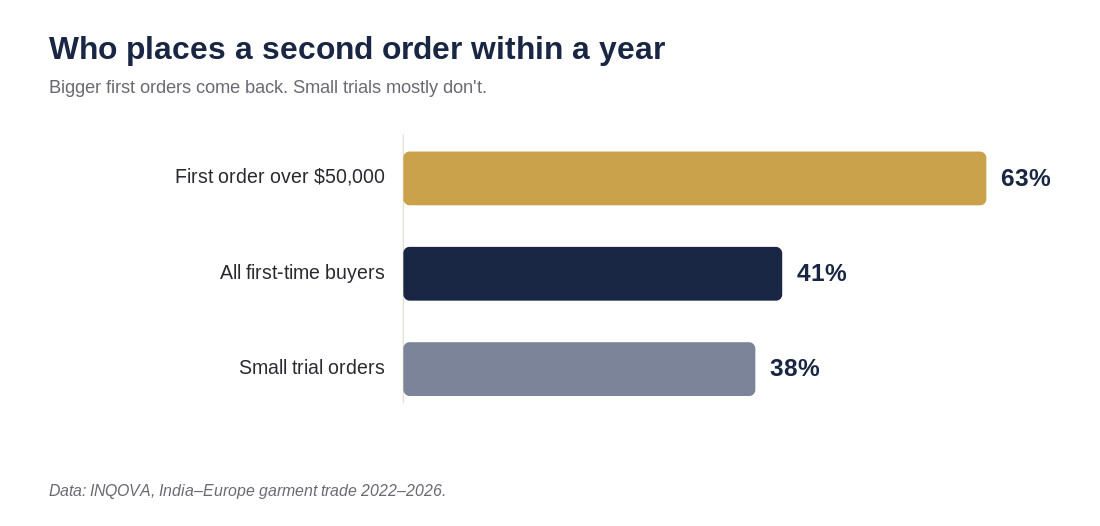
Most first orders never get a second one. Only 41% of first-time buyers placed a second order within a year, and most of that decision lands in the first six months. The size of the first order tells you a lot: orders above 50,000 dollars came back at 63%, while small trials came back at just 38%. The buyer who commits returns; the half-convinced one places a test and disappears.
Attrition is real: of the Indian exporters who entered the EU lane in the recent year, fewer than half were still shipping twelve months later. As INQOVA puts it, entry is cheap, staying is the game (INQOVA).
What is the reward for the suppliers who stay?
The reward for staying is steep. Buyers who come back typically more than double their business in the first year, and in INQOVA's three-year analysis, several small trial orders became programmes worth millions within eighteen months.
Established relationships compound. 79% of the million-dollar buyer relationships from 2022 are still buying today. European buyers are narrowing their supplier lists and putting more volume through fewer partners they trust, so a small share of suppliers now carries most of the value in the lane. Getting onto that shorter list, INQOVA argues, is the whole game.
What do European buyers check before they commit?
European buyers now decide from a screen before they ever make contact, according to INQOVA. This should change how you prepare: a supplier they can't find isn't compared, they're simply absent.
Before they trust you, buyers verify who you are, what you make, who you already supply, and what certifies it. Cost alone no longer wins a place. Buyers are trimming their lists and re-screening on compliance, traceability and reliable delivery. Compliance readiness is becoming a gate, not a bonus, traceability documentation and the EU's coming digital product passports among them. And the trial order, INQOVA notes, is an audition for responsiveness as much as for quality.
Why does timing decide who wins?
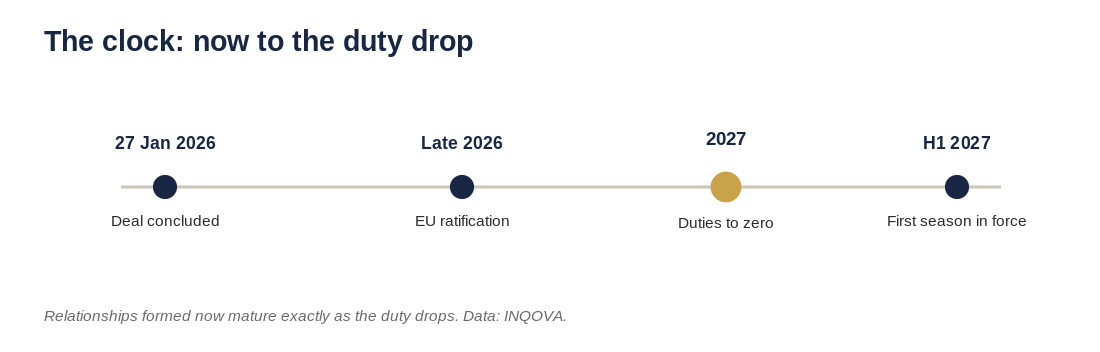
The duty arrives for every Indian exporter on the same day, so timing is the last piece. EU ratification runs through late 2026, and the duty advantage arrives in 2027. The duty won't make you special; it makes everyone cheaper at once. What separates you is whether a buyer can already find and verify you when that day comes.
New relationships form fastest in the first half of each year, and the first half of 2027 is the deal's first season in force. Which means the relationships you form now mature exactly as the duty drops. INQOVA's closing line is the whole brief in three words: be findable, be verifiable, get chosen (INQOVA).
The numbers at a glance
Tariff figures are public (EU-India FTA / trade press); the trade-flow figures are from INQOVA's June 2026 briefing.
- 9.6% → 0%: garment duty with REX (GSP) today versus under the FTA; 12% standard rate (trade press).
- ~$500m a year: what the duty drop is worth to Indian garment exporters at today's volumes.
- 3,000+ buyers: placed a first-ever order with an Indian supplier in 2025.
- 41% / 38% / 63%: second-order rates overall, for small trials, and for first orders above $50k.
- Under 50%: of new Indian exporters were still shipping twelve months on.
- 79%: of 2022's million-dollar buyer relationships are still buying today.
How can a trade show help you get found and verified?
A trade show is the fastest way to clear INQOVA's three tests. Be findable, be verifiable, get chosen describe a screen, and standing in front of the buyer clears all three faster than any website.
A buyer scanning suppliers online is doing detective work, piecing you together from photos and PDFs. At a trade show, that work collapses into a five-minute conversation. They see the product, feel the fabric, read you, and check the things INQOVA says they screen for, who you supply, what certifies you, how quickly you answer, without a single email. Found and verified in one meeting (see the shows we represent).
It also works on the part INQOVA calls the real game: turning a trial into a programme. The buyer who met you, liked the collection and trusts the person behind it is the one who comes back with the bigger second order. Face time is a large part of what moves a brand from the 38% to the 63%.
The geography lines up too. INQOVA's data shows France opens the most new relationships, and Paris during the shows is where European buyers gather to source. That's exactly where we work. A stand at Who's Next or Première Classe puts you in that room in the months before the duty drops, so your relationships mature right as the tariff hits zero.
Our reading, in one line: the duty is the opening; being chosen is the work, and it happens in front of a buyer.
If you want to form those relationships before the duty drops, the next Paris windows are this season. Apply here, or book a 30-minute call.
Sources
- INQOVA Technologies Ltd., "The Current EU-India Window," June 2026
- Indian Textile Magazine, the EU-India FTA and textile/apparel zero-duty
- CNBC, India-EU trade deal: tariffs and who benefits (27 Jan 2026)
- European Commission, Access2Markets: GSP and REX
- Policy Circle, EU GSP withdrawal and Indian exporters